

7.5K
Downloads
46
Episodes
New episodes available September 22, 2026.
What happens when the life you thought you were living suddenly falls apart?
More than twenty years ago, a series of life-altering events led Bradley Hall through what he now describes as an identity crisis and egoic collapse — an experience that shattered his assumptions about who he was, what he believed, and how he understood himself.
That journey sparked a lifelong exploration of psychology, mindfulness, trauma recovery, spirituality, resilience, and human transformation. Today, The Bradley Hall Show explores the questions that surface when life forces us to reinvent ourselves — and how we grow through adversity into a deeper, more authentic version of who we actually are.
Hosted by Bradley Hall — a trauma-informed coach, mindfulness teacher, veteran, former firefighter, and advocate for personal transformation — the show features real conversations with experts, authors, researchers, thought leaders, and everyday people with extraordinary stories.
The podcast began with a focus on DNA discoveries, Non-Paternal Events (NPEs), family secrets, and identity disruption. Over time, it has evolved into something bigger — a broader exploration of identity, healing, relationships, purpose, mindfulness, psychological growth, leadership, spirituality, and human potential.
Whether you're navigating a major life transition, recovering from loss or trauma, searching for deeper meaning, or simply working to become the best version of yourself — you'll find practical insights, inspiring stories, and the kind of thoughtful conversations that actually move the needle.
Because sometimes losing who you thought you were is the first step toward becoming who you were meant to be.
Episodes

3 hours ago
3 hours ago
24 min
Are You Code-Switching or Surviving?
Before you walk into the room, do you make adjustments?
Maybe you change your voice, choose different words, soften an opinion, hide part of your story, or make yourself more agreeable. Sometimes that's simply social awareness. We all adapt to different people and situations.
But what happens when adapting doesn't feel like a choice?
In this episode of The Bradley Hall Show, Bradley explores the difference between healthy social adjustment and the constant self-monitoring that can develop when acceptance, opportunity, connection, or safety depends on how well we manage other people's reactions.
This episode traces the origins of code-switching, its particular significance for marginalized communities, and the broader human experience of learning to edit ourselves in order to belong. Bradley also shares personal experiences that shaped his understanding of race, parenting, identity, and the cost of minimizing himself.
You'll learn five questions that can help you recognize when adaptation is serving you, and when it may be becoming self-abandonment:
- What am I changing?
- What am I trying to protect?
- What evidence do I have about this environment?
- What does this adjustment cost me?
- What would five percent more freedom look like here?
The goal isn't to stop adapting. Privacy isn't shame. Strategy isn't fraud. Sometimes adaptation is necessary.
The goal is to recognize when you're choosing it, and when an old survival strategy is still making the choice for you.
In this episode: code-switching, identity, belonging, authenticity, hypervigilance, cultural identity, family systems, self-abandonment, survival strategies, boundaries, and psychological safety.
Learn more about Bradley's identity-focused coaching and download the free guide You're Not Who Happened to You at thebradleyhall.com.
Follow The Bradley Hall Show and share this episode with someone who may be spending more energy translating themselves than they realize.
Experience shapes perception. Awareness creates choice.

Sep 29, 2026
Sep 29, 2026
29 min
The different versions of you | Episode 44
Why can you feel confident and capable in one room, then guarded, anxious, agreeable, or younger in another?
Different people, places, and roles bring out different versions of us. That doesn't mean one version is real and the others are fake. Human beings are contextual, and adapting to our surroundings can be healthy.
But what happens when adapting turns into self-erasure?
In this episode, Bradley shares what he learned moving between the firehouse and a depth psychology classroom, and how being raised to minimize himself shaped who he became in new groups. Together, you'll explore:
- Why different environments activate different parts of us
- How family roles and belonging strategies become identities
- Why certain relationships bring older versions of us forward
- The difference between consistency and authenticity
- How to tell healthy adaptation from self-erasure
- Five questions for understanding who you become in different rooms
- How to reconnect parts of yourself that have been confined to certain roles or relationships
The goal isn't to be the same person everywhere. It's to stay connected to your values, your voice, and your choices while you respond to the room you're in.
As you listen, consider:
Where do you feel most like yourself?
Where do you find yourself editing who you are?
And what do you believe would happen if you stopped?
Experience shapes perception. Awareness creates choice.
Learn more about The Bradley Hall Show: https://thebradleyhallshow.com
For identity-focused coaching and the free guide "You're Not Who Happened to You," visit https://thebradleyhall.com

Sep 22, 2026
Sep 22, 2026
19 min
Most of the losses that change us don't come with a funeral.
A career ends. A marriage dissolves. A diagnosis changes the future you imagined. You leave a faith, a country, or a community. A DNA discovery rewrites your family story. From the outside, life may look almost the same. Inside, something fundamental is gone.
In this episode, Bradley explores ambiguous loss, disenfranchised grief, and the identity losses that often go unrecognized by the people around us. He shares what happened after an injury ended his career as a firefighter. He also shares how learning that the man on his birth certificate was not his biological father left him grieving a version of himself that no longer existed.
You'll learn why unrecognized grief can get stuck and why conflicting emotions do not invalidate your loss. You'll also get three sentences to help you give grief an honest place in your story:
- What I lost was…
- What I needed and didn't get was…
- What does this grief need from me now?
Moving forward doesn't mean the loss didn't matter. It means your life is bigger than the absence.
Download Bradley's free guide, You Are Not Who Happened to You: https://thebradleyhall.com
Learn about working with Bradley one-on-one: https://thebradleyhall.com
If this episode helps you name something you've been carrying, follow The Bradley Hall Show, leave a rating or review, and share it with someone who may need permission to call their loss a loss.
Experience shapes perception. Awareness creates choice.

Sep 15, 2026
Sep 15, 2026
20 min
Why do you feel instantly safe with people who look, sound, or think like you? In this episode of The Bradley Hall Show, identity coach and NPE advocate Bradley Hall explains mirroring: the wiring that makes your head turn when you hear your own accent in a foreign airport, why babies show it by three months old, and what happens to people who grow up without anyone who reflects them.
Bradley traces the pull back to its roots. For most of human history, a stranger was a risk, and the nervous system still scans every room asking one question: is this person mine? Looks, accent, and culture are just the fastest answers it has. Give it a better one and the looks stop mattering.
You'll learn the four kinds of mirroring (physical, behavioral, emotional, cultural), why the missing mirror turns difference into defect, and how to tell the difference between recognizing yourself in someone and handing them ownership of your identity.
Bradley shares the first time he saw a photo of a biological relative after his NPE discovery, and what he learned in the fire service about people who share no blood and no hometown recognizing each other in minutes.
This episode is for anyone rebuilding identity after a DNA surprise, adoption, or donor conception, anyone who grew up between cultures, and anyone who has ever been the only one like them at the table: the first in the family to go to college, the one who left the faith, the veteran who came home, the person whose marriage ended.
Experience shapes perception. Awareness creates choice.
In this episode:
- Why humans are wired to trust the familiar and watch the unfamiliar
- What infants and minimal-group experiments reveal about in-group bias
- The four kinds of mirroring and how each one shapes identity
- Why difference starts to feel like defect when nobody reflects you
- Recognition versus belonging, and the risk of borrowing an identity
- How to be a better mirror for the people you love
- A three-person reflection practice to run this week
Free guide: You Are Not Who Happened to You at https://thebradleyhall.com
Join the inner circle: bonus episodes, every course in the Academy for Integrative Health at no extra cost, and private access to Bradley. Membership is opening soon. Get on the list at https://thebradleyhall.com
Booking Bradley for keynotes or podcast interviews: https://thebradleyhall.com/speaking
Season 2 of The Bradley Hall Show, "Identity & Belonging," explores identity disruption and reconstruction for NPEs, third culture kids, and anyone whose story changed. New episodes every Tuesday on Spotify, Apple Podcasts, and YouTube.

Sep 8, 2026
Sep 8, 2026
12 min
Why don't you feel at home in the place, culture, or family you came from? In this episode of The Bradley Hall Show, identity coach and NPE advocate Bradley Hall explains why belonging on paper is not the same as being seen, and how to build a sense of home you actually chose.
Bradley shares his own NPE discovery (learning through a DNA test that his birth certificate father was not his biological father) and the identity disruption that followed. He walks through how family, culture, geography, and relationships assign you a definition of home before you're old enough to question it, and what it takes to rewrite it.
You'll get a simple home audit you can run this week to find where you feel safe, seen, connected, and free to be yourself, and where you're living out someone else's story.
This episode is for anyone rebuilding identity after a DNA surprise, growing up between cultures, a move across borders, a family estrangement, a divorce, a job loss, or the slow realization that the life you were handed doesn't fit.
Home might be a place, a relationship, a community, or the moment you finally belong to yourself. What matters is that the definition is yours.
Experience shapes perception. Awareness creates choice.
In this episode:
- The difference between belonging and being recognized
- How DNA surprises, cross-cultural upbringing, and estrangement disrupt your sense of home
- Five forces that shape belonging: family, culture, geography, relationships, values
- The home audit: four questions to ask about every space in your life
- Rebuilding identity on your own terms
Join the inner circle: bonus episodes, every course in the Academy for Integrative Health at no extra cost, and private access to Bradley. Membership is opening soon. Get on the list at https://thebradleyhall.com
Booking Bradley for keynotes or podcast interviews: https://thebradleyhall.com/speaking
Season 2 of The Bradley Hall Show, "Identity & Belonging," explores identity disruption and reconstruction for NPEs, third culture kids, and anyone whose story changed. New episodes every Tuesday on Spotify, Apple Podcasts, and YouTube.

Sep 8, 2026
Sep 8, 2026
32 min
You can be in a room full of people who love you and not be seen by any of them. That isn't an accusation. It's something ordinary that happens in good families, with nobody at fault.
Loving someone and seeing someone are two different things. In this episode of The Bradley Hall Show, we look at what being seen actually is, why it lands with more force than it seems it should, and what happens when the people closest to you are certain they have you right and don't.
If you're an NPE, a third culture kid, going through a divorce, an estrangement, a career ending, or any moment where your story has changed, this one is for you. Right when you most need other people to help you find out who you are now, they're the least equipped to do it. They're seeing the file, not you.
We cover:
- The difference between being noticed, praised, needed, and seen
- Why recognition runs on the oldest machinery you have (Cooley, Winnicott, and Kohut on the looking-glass self and mirroring)
- Misrecognition: the state worse than not being seen at all
- The trap of managing your presentation, and the wrong conclusion it leads to
- One small thing you can do instead of "go find your people"
- Why external recognition should confirm your self-understanding, not supply it
Season 2 of The Bradley Hall Show is about identity and belonging: what disrupts them, what rebuilds them, and what becomes possible when you understand what shaped you.
Join the free Examined Living community: https://examined-living-791f8b.circle.so
Experience shapes perception. Awareness creates choice.
Bradley Hall is a trauma recovery coach (CTRC-S), IAOTRC faculty member and approved supervisor, author, and creator of the Hall Human Development System. He holds an M.A. in Depth Psychology from Pacifica Graduate Institute.
being seen, feeling unseen, identity, belonging, mirroring, looking-glass self, misrecognition, NPE, DNA discovery, identity disruption, trauma recovery, third culture kid, estrangement, self-understanding, personal growth, depth psychology, Winnicott, Kohut, Cooley

Sep 1, 2026
Sep 1, 2026
27 min
There is a particular morning people describe to me, and they describe it almost identically no matter what happened to them. You wake up. For about four seconds everything is ordinary. And then you remember.
Nothing in the room has changed. Not one object, not one person, not one fact about your history. You could take an inventory of your entire life and find everything exactly where you left it. And you would still not be sure you are the same person.
That experience gets dismissed constantly, including by the people having it. It is not an overreaction. Something real is happening, it has a shape, and once you can see the shape you can do something about it.
In this episode Bradley works through identity disruption: what actually gets hit when one fact changes, why your past can stay identical while its meaning shifts completely, and why the same photograph can be a warm memory in March and unbearable in April.
He also takes on the sentence almost everyone hears. You are still the same person. Nothing has really changed. The people saying it mean well, and on the level of facts they are not wrong, but they are answering a question you did not ask. That is why it isolates instead of comforting.
And there is a warning against the thing instinct pushes you toward. When identity comes apart, the pull is to resolve it immediately, to swap one fixed answer for another. The people who move fastest to a new answer often end up doing the work twice.
In this episode:
- What identity disruption actually is, and why the term comes from trauma, adoption, and grief work rather than from anywhere new
- Why so much of what you call yourself started as information somebody else handed you
- The difference between the facts of your life and the meaning you assigned to them
- How a meaning becomes a habit, a habit becomes a trait, and a trait starts feeling like your nature
- Why grief with no death attached to it is still grief
- Why "nothing has really changed" lands the way it does
- Six questions that are actually answerable, when "who am I now" is not
Next episode: Belonging. Why the need for it runs deeper than we credit, what happens to someone who never quite feels it anywhere, and why it is not a personality problem.
New episodes one to two times per week. Runtime: 27:36
The Bradley Hall Show explores identity disruption and reconstruction. Across this season, Bradley works through what happens when the story you built your life around stops being true, whether that came from a DNA surprise, a divorce, a job loss, a move between cultures, or any other loss of the self you knew. Each episode ends the same way.
Experience shapes perception. Awareness creates choice.
MORE INFO
Start here: https://www.thebradleyhall.com/start-here
Free guide, You're Not Who Happened to You: https://start.thebradleyhall.com/guide
Join the free Examined Living community: https://examined-living-791f8b.circle.so

Sep 1, 2026
Sep 1, 2026
15 min
Where are you from? For most people it is small talk. Four seconds, no perceived cost. For some of us, that question opens a door.
Because the honest answer is longer than the moment allows. It involves a place you left, or a family story that turned out not to be accurate, or two countries and a passport that names one of them. So you build a short version. A clean one. And every time you use it, you notice the distance between the answer you gave and the answer that is true.
That distance is what this show is about.
If you have listened before, this one sounds different, and Bradley explains why. The Bradley Hall Show is built in seasons now. One subject per season, worked in order, mostly solo episodes, fifteen to twenty minutes each. An argument that builds instead of a new topic every week. Everything in the main feed stays free.
If you are new, here is the short version of what you have found. Bradley Hall works with people whose understanding of who they were came apart, usually without warning and usually in a single afternoon. That work started with NPEs, people who took a DNA test and learned the family story they were given was not the story their biology told. It is still that work. But the questions were never staying inside one community. The adoptee asks them. So does the person raised between two countries, the immigrant's kid who is one person at home and another at school, the person who left the religion they were raised in, and the person whose career ended and took a large piece of their self-understanding with it.
Different lives. The same handful of questions. Where do I belong. Who gets to decide who I am. Why does the way people see me not match the way I experience myself. What do I do when the story I was handed does not fully explain me.
Season one is twenty episodes on identity and belonging, and this is where it starts.
In this episode:
- Why "Where are you from?" is a harder question for some people than it looks
- What changed about the show and why the format is different now
- Who this season is for, and why the audience is wider than where it started
- What the twenty episodes cover, from identity disruption through grief, adaptation, and integration
- What begins in January, and why this season is the ground it stands on
Next episode: Who am I when my story changes. What happens inside a person when the account they have been living inside stops matching what they now know, and why people telling you nothing has really changed makes it worse rather than better.
New episodes one to two times per week. Runtime: 15 minutes.
Experience shapes perception. Awareness creates choice.
MORE INFO
Start here: https://www.thebradleyhall.com/start-here
Free guide, You're Not Who Happened to You: https://start.thebradleyhall.com/guide
Join the free Examined Living community: https://examined-living-791f8b.circle.so

Jun 6, 2022
Jun 6, 2022
1 hr 27 min
Jodi Girard returns to update us on her personal journey since her shocking DNA discovery.
Be sure to subscribe to Bradley's YouTube channel to receive notifications of future episodes on trauma recovery, personal growth, and holistic health.
Bradley is a childhood trauma survivor. He utilizes his unique experiences, extensive education, and talents to help others navigate the normal challenges of their daily lives to help them create the life they desire and deserve. He is a certified mindfulness instructor and trauma recovery coach with over 30 years of coaching and mentoring experience. He specializes in helping facilitate foundational awareness and personal growth with his clients. He founded the Life In Truth Academy in 2019 to offer personal growth and healing education to a wider audience.
He is currently pursuing his PhD in Depth Psychology at Pacifica Graduate Institute in Santa Barbara, CA. He is the creator and host of his podcast, The Bradley Hall Show.
More information at: www.thebradleyhall.com.
#NPE #MPE #geneticsurpirse #dnadiscovery #dnasurpise #familysecrets #donorconvieved #adoption #latediscovery #mentalhealth #trauma #ptsd #TraumaCoaching #LifeCoaching #mentalhealthawareness #healing #podcast #mindfulness #depression #psychology #jung #anxiety #selfcare #selflove #meditation #wellness #holistichealth #thebradleyhall #ethnicity #forgiveness #therapist #socialwork #stress #dna #recovery #selfhealing #cptsd #genetics #epigenetics #heritage #genealogy #23andme #ancestry #dna #identity
May 16, 2022
May 16, 2022
1 hr 27 min
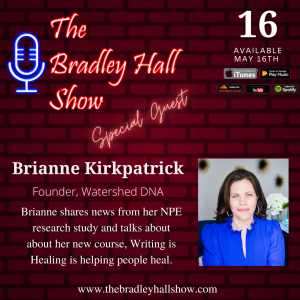
Brianne Kirkpatrick, Founder of Watershed DNA, shares new information gleaned from a study of 20,000 people who experienced a surprise discovery while taking an at-home DNA test. We discuss the impact on the NPE community. We also discuss Brianne's new online course, Writing is Healing, an online healing course that utilizes the power of creativity to heal, and her upcoming presentation at the annual NPE Virtual Retreat in June of 2022. For more information, go to www.thebradleyhall.com.
Be sure to subscribe to Bradley's YouTube channel to receive notifications of future episodes on trauma recovery, personal growth, and holistic health.
Bradley is a childhood trauma survivor. He utilizes his unique experiences, extensive education, and talents to help others navigate the normal challenges of their daily lives to help them create the life they desire and deserve. He is a certified mindfulness instructor and trauma recovery coach with over 30 years of coaching and mentoring experience. He specializes in helping facilitate foundational awareness and personal growth with his clients. He founded the Life In Truth Academy in 2019 to offer personal growth and healing education to a wider audience.
He is currently pursuing his PhD in Depth Psychology at Pacifica Graduate Institute in Santa Barbara, CA. He is the creator and host of his podcast, The Bradley Hall Show.
More information at: www.thebradleyhall.com.
#NPE #MPE #geneticsurpirse #dnadiscovery #dnasurpise #familysecrets #donorconvieved #adoption #latediscovery #mentalhealth #trauma #ptsd #TraumaCoaching #LifeCoaching #mentalhealthawareness #healing #podcast #mindfulness #depression #psychology #jung #anxiety #selfcare #selflove #meditation #wellness #holistichealth #thebradleyhall #ethnicity #forgiveness #therapist #socialwork #stress #dna #recovery #selfhealing #cptsd #genetics #epigenetics #heritage #genealogy #23andme #ancestry #dna #identity